Painting is poetry that is silent…
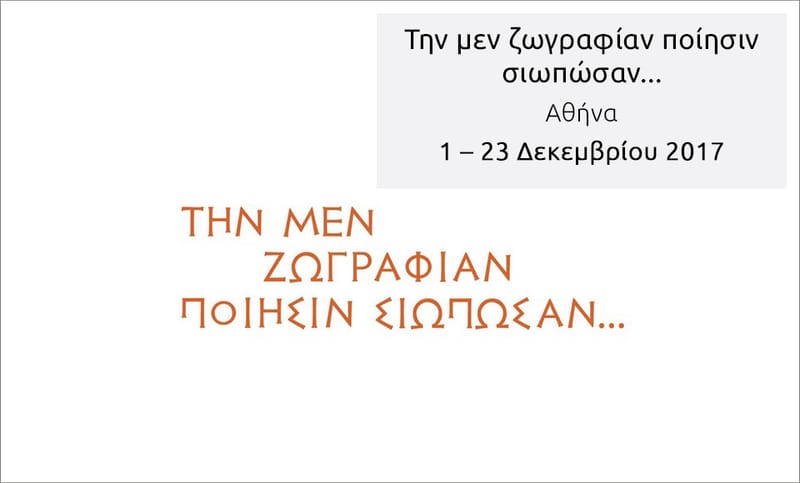
Group painting exhibition: “Painting is poetry that is silent…”
PRESS RELEASE
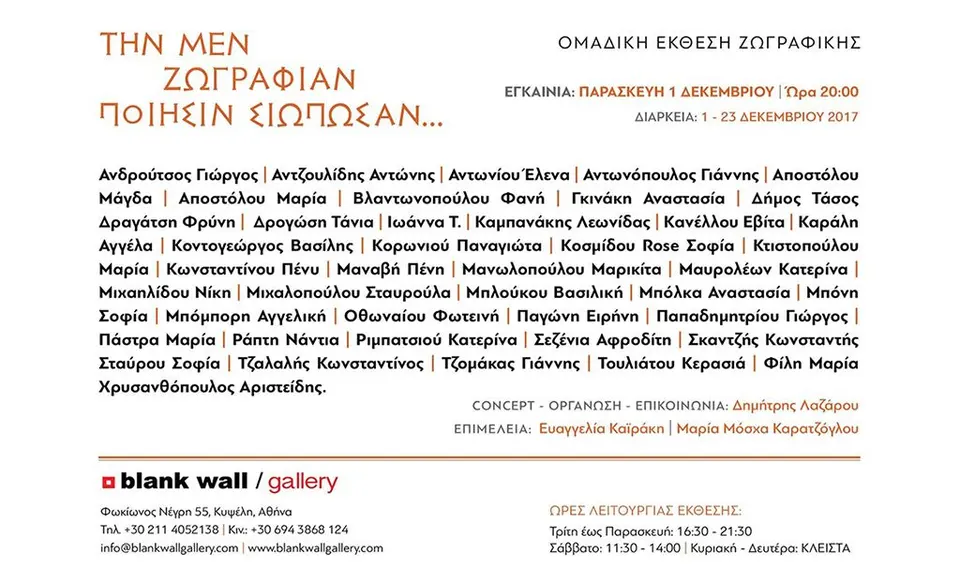
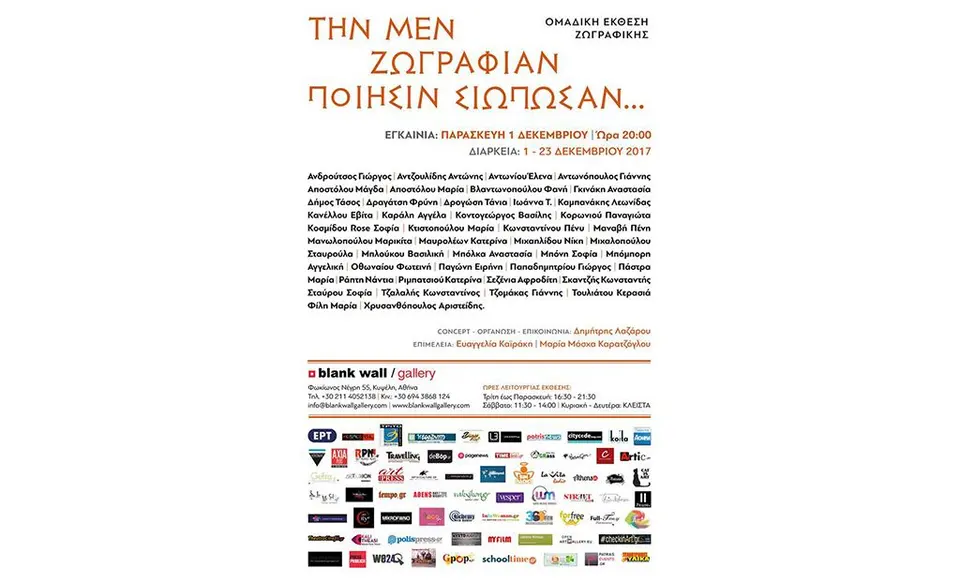
For the first time, Blank Wall Gallery (Fokionos Negri 55, Kypseli), known for the outstanding photography exhibitions it presents, will host in its space, from 1 to 23 December, a group painting exhibition entitled “Painting is poetry that is silent…”, with 43 contemporary Greek artists taking part. The exhibition is curated by the art historians Evangelia Kairaki and Maria-Moscha Karatzoglou, while Dimitris Lazarou is responsible for its concept, organisation and communication.
The title of the exhibition is taken from the well-known maxim of the ancient Greek lyric poet Simonides of Ceos, “painting is poetry that is silent, and poetry is painting that speaks”. It was chosen as the theme because this is the first time Blank Wall Gallery has hosted a painting exhibition, and because, according to the maxim, painting is poetry (creation) that is silent: the viewer of a painting takes in its messages on the basis of his or her own criteria, personal experience and knowledge. For this reason none of the works in the exhibition will have titles, leaving viewers free to look at them, to form their own judgements and draw their own conclusions, and to let their feelings run free as they look, without being bound by a title.
The art historians Evangelia Kairaki and Maria-Moscha Karatzoglou note: “Within a single, unbroken space, where what is sought is, on the one hand, formal autonomy – the painterly rendering or the verbal utterance of the visual/linguistic composition – and, on the other, its content and aims, the visual arts and literature meet. Painting, then, as silent poetry, since it refers to actions happening at this very moment, and poetry as speaking painting, since it refers to actions that have already happened (‘For the deeds that painters show as they are happening, words recount and record once they have happened’ – Plutarch), converse, reflect, converge and interact through different sensory paths, their common denominator being mimesis, in Aristotle’s sense, of visual appearances and of human actions respectively. The prerequisite is the idea, self-sufficient and thoroughly worked out, as the lever of creation.
The prima idea, which goes beyond the formal boundaries that set each art apart, is visualised through gesture and given meaning through language, opening a dialogue between creator, viewer and reader, signifier and signified. What is sought is the osmosis of the arts. Painters and poets at the end of the 19th century experimented with the mingling of the senses, with synaesthesia. The question came to the fore again in the first half of the 20th century, this time specifically as the combination of word and image, in movements such as Dada, the Russian avant-garde and Futurism, and it reached its height with the birth of conceptual art in the 1960s, an art of questioning par excellence, in which the leading part was played, fittingly, by the group with the eloquent name Art & Language.
In the end, though, beyond any systematic attempt to join poetry and painting, poetry wells up from painting, and from art in general, in any case. Language is stirred in the viewer, in the form of feelings, thoughts, memories, agreements and disagreements too. As Goethe used to say: I am resolved to live in wholeness, goodness, beauty. And as Simonides of Ceos said, in one of his epigrams that has come down to us intact, in its characteristic Ionic dialect: tis gar hadonas ater thnaton bios potheinos e poia tyrannis? tas ater oude theon zelotos aion (What human life, what power, is desirable without pleasure? Without it not even the life of the gods would be enviable). With the art object as their axis, then, and the stimulation of the senses and the intellect as their priority, 43 artists mark out an imaginary visual space in which painting, through the experience of seeing, is enlisted as both language and expressive act to narrate – at times representationally, at times allusively – to articulate meanings, to set desires free, to dive into the folds of the human soul. Making poetry is, after all, the most innocent of occupations!”
Participating artists: George Androutsos // Antonis Antzoulidis // Elena Antoniou // Giannis Antonopoulos // Magda Apostolou // Maria Apostolou-Nicolopoulou // Fani Vlantonopoulou // Anastasia Ginaki // Tasos Dimos // Frini Dragatsi // Tania Drogossi // Ioanna T. (Ioanna Tzamba) // Leonidas Kabanakis // Evita Kanellou-Doufexi // Angela Karali // Vasilis Kontogeorgos // Panagiota Koroniou // Sofia-Rose Kosmidou // Maria Ktistopoulou // Penny Konstantinou // Penny Manavi // Marikita Manolopoulou // Katerina Polyzoidis Mavroleon // Niki Michailidou // Stavroula Michalopoulou // Vassiliki Bloukou // Natasa Bolka // Sofia Boni // Ageliki Bobori // Fotini Othoneou // Eirini Pagoni // Giorgos Papadimitriou // Maria Pastra // Nadia Rapti // Katerina Rimbatsiou // Afroditi Sezenia // Konstantis Skantzis // Sofia Stavrou // Konstantinos Tzalalis // Giannis Tzomakas // Kerasia Touliatou // Maria Fili // Aristeidis Chrysanthopoulos
GENERAL INFORMATION ABOUT THE EXHIBITION:
Opening: Friday 1 December, 20:00–23:00
Exhibition dates: 1–23 December 2017
Concept – Organisation – Communication: Dimitris Lazarou
Curators: Evangelia Kairaki, Maria-Moscha Karatzoglou
Spots – videos: Tasos Petsas
The instrumental piece “Angel of mine”, which provides the music for the videos and spots, was composed by Tasos Petsas.
English translations: Leonidas Kabanakis
Blank Wall Gallery
Fokionos Negri 55, Kypseli, Athens
Tel. +30 211 4052138
Mobile: +30 694 3868 124
Email: info@blankwallgallery.com
Website: www.blankwallgallery.com
Exhibition opening hours
Tuesday to Friday: 16:30–21:30
Saturday: 11:30–14:00
Sunday – Monday: CLOSED
FREE ADMISSION!!!